Yaks, Explained: The Real MVPs of Every Himalayan Trek
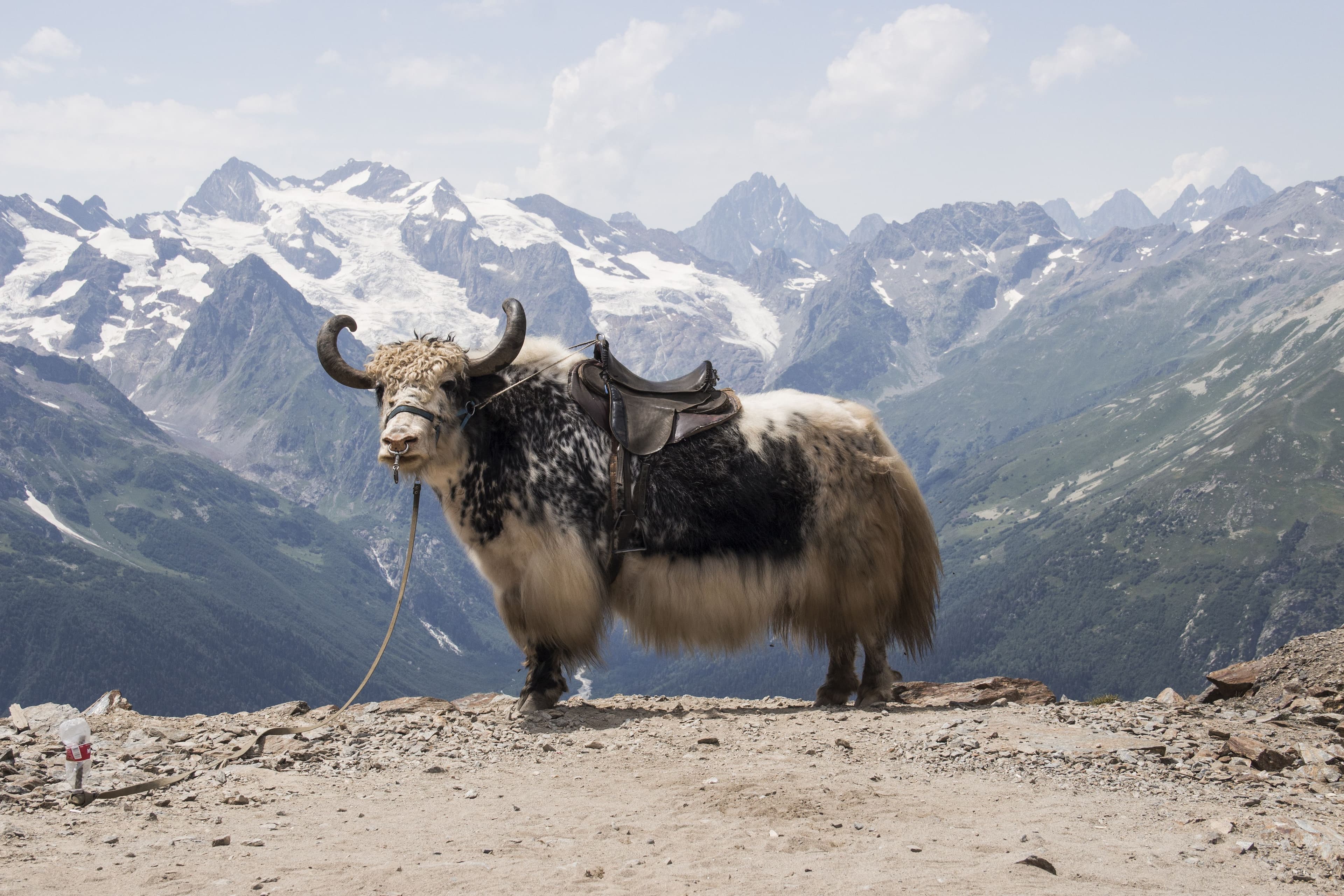
Somewhere around day two of most Himalayan treks, you'll step aside on the trail to let a train of enormous, shaggy animals pass - bells clanking, loaded down with duffel bags, gas canisters, and someone's entire kitchen. You'll probably think "oh, a yak," snap a photo, and keep walking. Fair enough. But there's more going on here than you'd think.
That's Probably Not Actually a Yak
Here's the twist: most of the animals you see on popular trekking routes below about 4,000m aren't pure yaks at all. They're dzo (or dzopkyo) - a yak-cattle hybrid bred specifically because they handle mid-altitude heat and terrain better than a purebred yak, which really only thrives above the tree line. Pure yaks tend to stay reserved for the higher, colder sections of a route, where dzo start to struggle.
So, if your guide casually says "yak" for the animal you saw at 3,000m, they're speaking colloquially - nobody on the trail is going to correct themselves mid-sentence for taxonomic accuracy, and honestly, neither will we for the rest of this post.
They're Doing Serious Work
A loaded yak or dzo can carry somewhere in the range of 60–100kg, depending on the animal, the terrain, and the load - tents, cooking gas, food supplies, sometimes even the wooden frames of camp furniture. On camping treks especially, they're doing a huge share of the heavy lifting that keeps your route on schedule, hauling gear ahead of the group so your camp is set up and dinner's underway by the time you arrive.
Those Bells Aren't Decoration
The deep clanging bell almost every yak wear isn't just atmospheric trail soundtrack - it's a genuinely practical tool. On narrow trails, blind corners, and in low visibility, the sound gives trekkers and other animal trains advance warning that a loaded yak is coming through. It also helps herders keep track of animals that wander off to graze during rest stops. Function first, ambiance second.
Yak Right-of-Way Is a Real Rule
If you take one practical thing from this post: always step to the uphill side of the trail when a yak train passes, never the downhill side. A loaded yak is heavy, momentum carries downhill, and the animals aren't always gentle about where they put their shoulders on a narrow path. Your guide will remind you constantly - it's not paranoia, it's just trail etiquette that keeps everyone (including the yak) safe.
They're Surprisingly Well-Adapted Athletes
Yaks are built for exactly this environment in ways that are honestly a little humbling to watch. Dense double-layered coats, oversized lungs and hearts relative to body size, and blood that's genuinely more efficient at carrying oxygen at altitude - while you're stopping to catch your breath at 4,500m, the yak walking past you is barely working. Millions of years of high-altitude evolution will do that.
So Next Time You Step Aside
Give them a nod. Somewhere behind that dead-eyed, unbothered expression is an animal quietly outperforming every piece of gear in your pack, carrying your dinner up a mountain you're struggling to walk up empty-handed. They've more than earned the right of way.