
Altitude Sickness & Acclimatisation
What altitude does to your body, how to prevent it, and how to recognise the warning signs that mean it's time to descend - essential reading before any trek or expedition above 3,000m.
Why Altitude Affects Everyone
Air at sea level and air at 5,000m contain the same proportion of oxygen - roughly 21%. What changes with altitude is atmospheric pressure. As pressure drops, oxygen molecules are spread further apart, so each breath you take delivers fewer of them into your bloodstream. Above roughly 2,500m, most people's bodies begin to notice this, regardless of how fit or experienced they are.
Susceptibility to altitude illness is largely genetic, not a matter of fitness or trekking experience. Marathon runners can develop AMS while first-time trekkers walk past them unaffected. This is precisely why our itineraries are paced for the altitude, not for how fast a group could physically move.
At Everest Base Camp (5,364m), atmospheric oxygen availability is roughly half of what it is at sea level.
The Three Tiers of Altitude Illness
Altitude illness exists on a spectrum. Understanding where each condition sits on that spectrum - and what it looks like - is what lets you and your guide catch it early.
AMS - Acute Mountain Sickness
Mild to ModerateThe most common altitude illness, affecting a large share of trekkers who ascend above 2,500m without proper pacing. It's your body's early signal that it hasn't caught up to the altitude yet.
Symptoms- Headache - usually the first and most reliable sign
- Nausea or loss of appetite
- Fatigue and general weakness beyond normal trekking tiredness
- Dizziness or lightheadedness
- Poor, disrupted sleep
- Mild shortness of breath on exertion
HACE - High Altitude Cerebral Edema
Medical EmergencyA rare but life-threatening progression of untreated AMS in which fluid builds up in the brain. It can develop within hours and is fatal within 24 hours if the person does not descend.
Symptoms- Severe headache that doesn't respond to painkillers
- Confusion, poor judgment, or irrational behaviour
- Loss of coordination (ataxia) - inability to walk a straight line
- Hallucinations or altered consciousness
- Extreme drowsiness, difficulty staying awake
HAPE - High Altitude Pulmonary Edema
Medical EmergencyFluid accumulates in the lungs rather than the brain, restricting oxygen exchange. It can occur alone or alongside HACE, and like HACE it requires immediate descent - no exceptions.
Symptoms- Extreme breathlessness, even at complete rest
- Persistent cough, sometimes producing pink, frothy sputum
- Tightness or gurgling/crackling sensation in the chest
- Bluish tinge to lips or fingertips (cyanosis)
- Rapid heart rate and unusual fatigue after minimal effort
How Acclimatisation Works
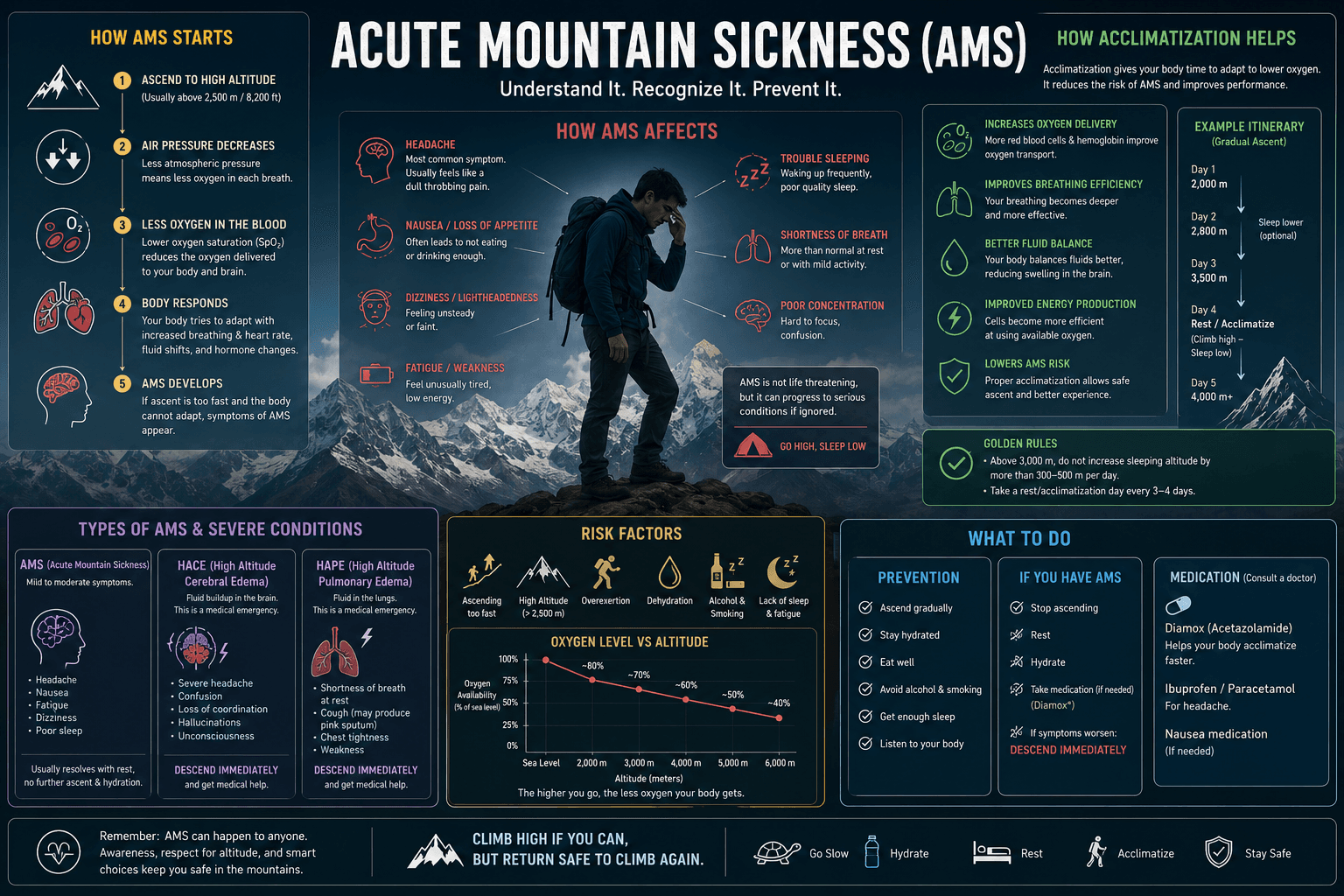
Acclimatisation is your body's gradual physiological adjustment to reduced oxygen availability. Given enough time, several things happen: your breathing rate and depth increase to pull in more air per minute, your kidneys help your blood carry oxygen more efficiently, and - over several days - your body increases red blood cell production, giving your blood a greater carrying capacity for the oxygen that is available.
This process takes time, which is why ascent rate matters more than fitness. The core principle guiding every itinerary we build is "climb high, sleep low." Hiking to a higher point during the day exposes your body to lower oxygen levels just enough to trigger adaptation, while returning to sleep at a lower altitude gives your body the recovery window it needs overnight - which is when you're most vulnerable to altitude illness, since breathing naturally slows during sleep.
Rest days aren't about stopping - they're about giving this internal adaptation process the days it physiologically requires before you ask your body to go higher still.
Golden Rules for Safe Ascent
Ascend gradually
Above 3,000m, avoid gaining more than 300–500m in sleeping altitude per day. Your daytime high point can be higher - it's the altitude you sleep at each night that matters most for adaptation.
Take built-in rest days
Our itineraries schedule an acclimatisation day roughly every 600–1,000m of net altitude gain. These aren't lazy days - you'll typically hike higher and return to sleep lower, which is the single most effective acclimatisation technique there is.
Stay well hydrated
Aim for 3–4 litres of water a day. Dry mountain air and faster breathing rates dehydrate you quickly at altitude, and dehydration mimics and worsens AMS symptoms.
Eat carbohydrate-rich meals
Carbohydrates require less oxygen to metabolise than fats or protein, making them the most efficient fuel source when your body is working with a thinner air supply.
Walk at a slow, steady pace
You'll hear your guide say "bistari, bistari" - slowly, slowly. Moving deliberately keeps your heart rate and oxygen demand manageable rather than spiking and crashing.
Report symptoms immediately
Fitness level has no bearing on who gets AMS - it's largely genetic. Tell your guide the moment you notice a symptom, however minor it seems. Early reporting is what keeps small issues small.
Avoid alcohol and sedatives
Both suppress your natural breathing rate overnight, which is precisely the mechanism your body relies on to adapt - avoid them entirely until you're back below 3,000m.
Diamox (Acetazolamide)
What it does
Diamox works by mildly acidifying your blood, which stimulates faster, deeper breathing. This isn't masking symptoms - it genuinely speeds up the same natural acclimatisation process your body would eventually complete on its own, by pulling in more oxygen sooner. Many trekkers take it prophylactically, starting one to two days before ascending above 3,000m and continuing through their highest days.
Common side effects are usually mild and include tingling in the fingers and toes, increased urination, and carbonated drinks tasting flat or metallic. It is a sulfonamide-derived medication, so anyone with a sulfa drug allergy should not take it.
Warning Signs - Descend Immediately
If you or anyone in your group shows any of these, stop ascending and descend - do not wait to see if it passes
- A severe headache that doesn't respond to standard painkillers
- Loss of coordination - stumbling, or an inability to walk a straight line
- Confusion, disorientation, or irrational behaviour
- Breathlessness even while sitting still
- A cough producing pink or frothy fluid, or a gurgling sound in the chest
- Bluish lips or fingertips
Descent is the only reliable treatment for HACE and HAPE. Even a few hundred metres of altitude loss can produce a rapid, noticeable improvement. Never continue ascending with any of these symptoms present, and never leave a symptomatic person alone.
How We Keep You Safe
Itineraries built around acclimatisation
Every route we run is paced against safe ascent-rate guidelines, with rest days placed at the altitude thresholds where they matter most - not squeezed in wherever is convenient.
Daily health monitoring
Guides carry pulse oximeters and check blood oxygen saturation and heart rate at key points on higher-altitude routes, catching early warning signs before they become visible symptoms.
Guides trained in altitude illness
Every lead guide is trained to recognise AMS, HACE, and HAPE and is authorised to alter the day's plan or turn a group around if a client's safety calls for it - no itinerary is more important than that.
Emergency evacuation protocol
We maintain established helicopter evacuation arrangements for high-altitude routes, so if descent on foot isn't fast enough, alternative evacuation can be triggered without delay.