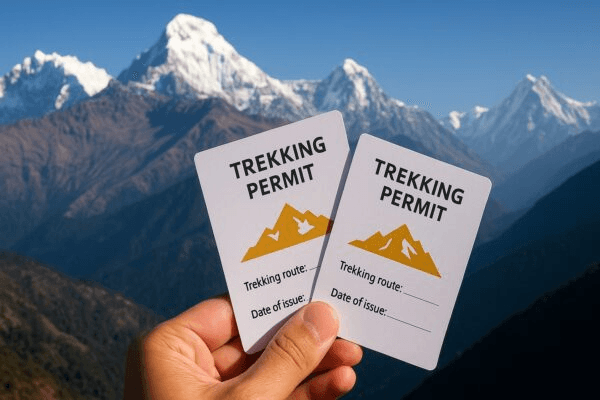
TIMS & Trekking Permits
Every permit you need for trekking in Nepal, what each one costs, which regions require what, and how Camping Trek handles the entire process for you.
Why Permits Exist
Nepal's trekking permit system serves three purposes: funding conservation and local infrastructure in the regions you're walking through, tracking trekker movement for search-and-rescue safety, and - in restricted border areas - regulating access for cultural preservation and security reasons.
Which permits you need depends entirely on your route. Open regions like Everest and Annapurna require a national park entry permit and a local fee. Restricted regions like Upper Mustang or Manaslu require special government-issued permits that only a licensed trekking agency can arrange on your behalf.
Camping Trek handles every permit application for you as part of your booking - you won't need to visit a single government office yourself.
Core Permits for Popular Regions
These are the permits required for Nepal's most-trekked regions - Everest and Annapurna - which together account for the large majority of trekkers each year.
TIMS Card
Trekkers' Information Management SystemA tracking card required for most independent trekking regions in Nepal, used by authorities to monitor trekker movement for safety purposes. Price depends on whether you're trekking with a registered agency (like Camping Trek) or independently - agency-organized trekkers pay a lower rate.
Required for most open trekking areas - not required in restricted or national-park-permit-only regions such as the Everest and Annapurna regions, where park entry permits serve the same tracking purpose.
Sagarmatha National Park Permit
Everest Region Entry PermitRequired entry permit for anyone trekking within Sagarmatha (Everest) National Park, including all standard Everest Base Camp and Three Passes routes. Checked at the park entrance in Monjo.
Anyone trekking in the Khumbu region, including Everest Base Camp, Gokyo Lakes, and Three Passes.
Annapurna Conservation Area Permit (ACAP)
Annapurna Region Entry PermitRequired entry permit for the Annapurna Conservation Area, covering Annapurna Base Camp, the Annapurna Circuit, Poon Hill, and Mardi Himal. Funds directly support conservation efforts within the region.
Anyone trekking in the Annapurna region on any of its standard routes.
Khumbu Pasang Lhamu Rural Municipality Fee
Local Entry Fee (Everest Region)A separate local-government entry fee for the Khumbu region, distinct from the national park permit. Introduced after the TIMS card was phased out specifically for the Everest region, so this now functions as the region's local tracking fee.
Anyone trekking in the Everest/Khumbu region, alongside the Sagarmatha National Park Permit.
Restricted Area Permits
Certain regions near Nepal's borders with Tibet and remote culturally-sensitive valleys require special restricted-area permits, issued only through a licensed agency and often requiring an accompanying guide throughout. Fees here are significantly higher than standard park permits, reflecting their limited-access status.
Upper Mustang
US $500 for first 10 days, then US $50/dayAmong the most expensive permits in Nepal, reflecting the region's status as a restricted former Tibetan kingdom. Requires trekking with a licensed agency and a minimum group size in most cases.
Manaslu Circuit
US $70–100/week depending on seasonHigher fees during peak season (September–November) than in the off-season. Requires an accompanying licensed guide at all times.
Nar Phu Valley
US $90–150/week depending on seasonA remote valley near the Annapurna region requiring a special restricted-area permit in addition to standard ACAP fees.
Kanchenjunga & Dolpo
US $10–20/week depending on areaLower fees than Mustang or Manaslu but still restricted, requiring agency arrangement and, for parts of Upper Dolpo, similarly high fees to Mustang.
What You Need to Provide
Valid passport
Original passport required at the time of permit issuance - photocopies alone aren't accepted.
Passport-sized photos
Bring 2–4 recent passport photos; some permits require an extra copy beyond what's used for your visa.
Payment
Most permits are paid in Nepali Rupees at the point of issuance - we handle exchange and payment as part of your trip package.
Group/agency details
Restricted-area permits require your trekking agency's registration details, which Camping Trek arranges directly with the Department of Immigration.
How Camping Trek Handles It
Permit paperwork is one of the most tedious parts of planning a Nepal trek - and one you won't have to think about when you book with us. Here's exactly how we manage it from start to finish.
We confirm your route and required permits
Once your itinerary is finalized, our team identifies exactly which permits your specific route requires - this varies significantly between regions and even between routes within the same region.
Documents collected before departure
We request your passport copy and photos in advance, either during booking or on your first day in Kathmandu, so nothing holds up the trek start.
Permits processed in Kathmandu
For most regions, permits are issued directly in Kathmandu before you fly or drive to the trailhead. Restricted-area permits can take a few extra working days to process through the Department of Immigration.
Checkpoints along the route
Permits are checked at official checkpoints along the trail - our guides carry and present all documentation, so you never need to manage this yourself mid-trek.
Trekking without a permit is illegal
Attempting a trek in permit-required areas without proper documentation can result in fines significantly higher than the permit fee itself, and in restricted regions can mean being turned back at checkpoints entirely. Fees also directly fund the conservation and local infrastructure of the regions you're trekking through - this isn't paperwork for its own sake.
One less thing to worry about
Every permit for your route is arranged, paid for, and carried by your guide as part of your Camping Trek package. All you need to bring is your passport and a couple of photos - we handle the rest.